


Buzzing through the Balkans

We come across beehives everywhere in the Balkans. Along country lanes, among fruit trees, and on sunny slopes. Especially in Slovenia, the bee seems deeply intertwined with daily life. The deeper we delve into it, the more the world of the honeybee amazes us.
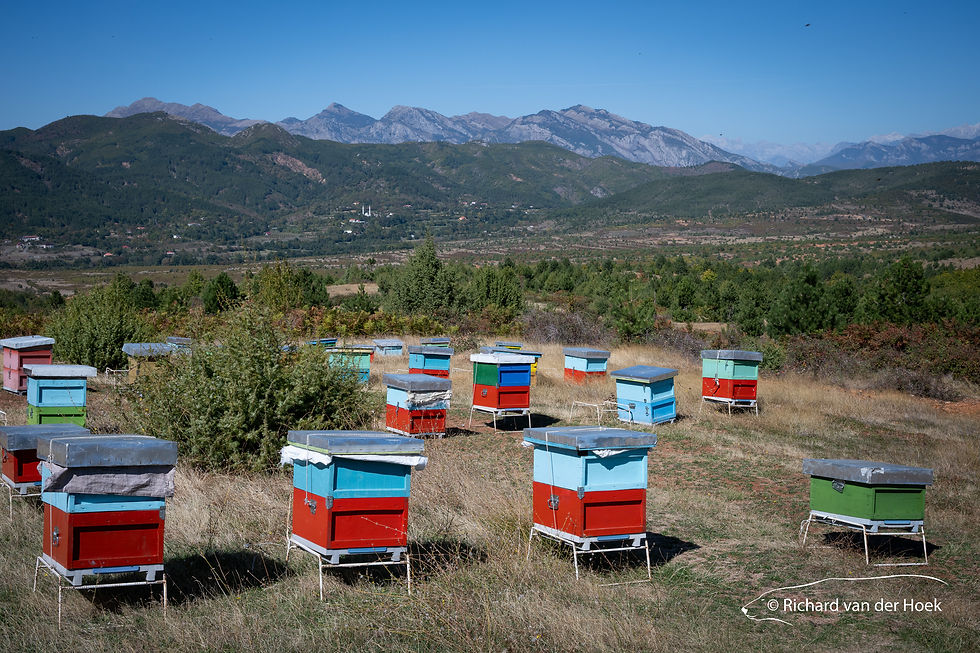
Slovenia and its bees
Slovenia is a true country of bees. Beekeeping is an age-old tradition there, and knowledge is passed down from generation to generation. The tradition is so deeply rooted that Slovenian beekeeping has been on the UNESCO List of Intangible Cultural Heritage since 2022. Knowledge about keeping bees has been passed down for generations, and we see traces of this everywhere in the landscape. No wonder we come across so many beehives here.
A temperature of 35 degrees
What particularly fascinates us is the way bees regulate their own living environment. Inside the hive, they keep the temperature remarkably constant, around 35 degrees Celsius. That is warm, especially considering that the outside temperature can fluctuate significantly. This warmth is essential for the development of the young bees. The bee colony therefore collectively ensures that the young bees receive exactly the conditions they need.
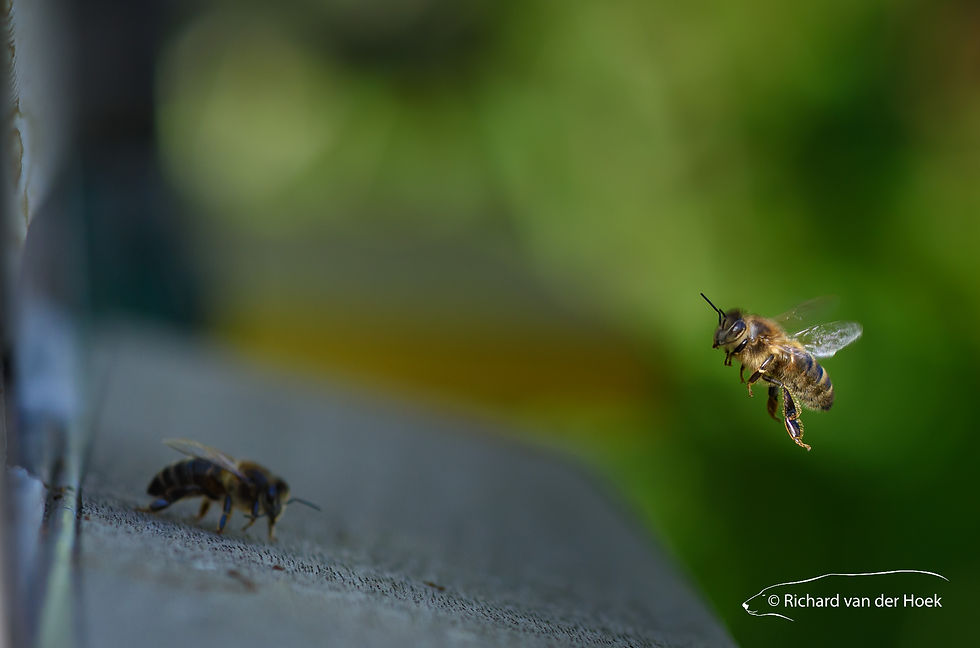
How bees warm themselves
When it gets cold outside, the bees huddle closer together. This is how they retain heat. Some worker bees can vibrate their flight muscles without actually flying. In doing so, they produce body heat, which they transfer to the combs and the brood. Other bees help distribute the heat. It is a beautiful interplay in which every bee contributes to the well-being of the whole. No central heating, no thermostat, just an ingenious interplay of living beings.
Whoever looks at a beehive sees a world in which everything is interconnected.
Cooling on hot days
Even when the sun heats up the hive considerably, the bees know what to do. Worker bees fly to the entrance and between the combs, flapping their wings. In doing so, they set the air in motion and expel warm air. Other bees collect water and spread small droplets throughout the hive. Evaporation creates cooling, similar to how sweat helps cool our bodies. In this way, they keep the brood nest within the correct temperature limits.
Support us:
Click on this banner and buy something at bol.com
A small percentage of the purchase goes towards funding this website.
The queen in the heart of the people
At the heart of the bee colony is the queen, surrounded by the worker bees who care for and protect her. The combs containing eggs and larvae form the center of the colony, while the other bees perform their duties around them. When you visualize this whole, the image of a living sphere emerges, with the queen and the young life in the middle. Every bee has its own task, but no hive can function without the cooperation of the entire colony. It is as if thousands of individual lives together form one larger organism.
A familiar world
The many beehives along the way remind me of my time at Weleda. The honeybee and its special significance within anthroposophical agriculture and medicine were frequently discussed there. Now that we see beehives everywhere here, it takes me back to that period for a moment.

The bee as a medicine

Take, for example, the medicinal properties of Apis (Latin for bee), which reflects the special relationship between the bee and the human thermoregulatory system. With a bee sting, we see how bee venom causes heat, redness, swelling, and a burning pain. It is precisely these properties that form the basis for the use of Apis in complaints with a similar presentation, such as acute inflammation with swelling and fluid accumulation. The underlying idea is that the characteristic action of the bee can help restore balance to the human thermoregulatory system and support the body's self-healing capacity.
A people of tens of thousands
In the summer, as many as 50,000 bees can sometimes live in a single hive. Yet such a colony remains constantly on the move. A worker usually lives only five to six weeks, while winter bees can live for several months and the queen can even live for four to five years. Individual bees come and go, while the colony as a whole continues to exist.
The wisdom of the bee
On the road with Globus 2, we are constantly surprised by what nature shows us. A row of beehives along the road is not just a collection of wooden boxes, but a world in itself. A world where warmth is guarded, cooperation is a matter of course, and every part contributes to the greater whole. And so, time and again, we discover that behind something seemingly ordinary lies a fascinating world.
Enter your email address at the bottom of this page and you will receive an email, at most once a week, when we post a new blog or video. Did you enjoy this blog? Then treat us to a cup of coffee via this link .



Comments